Visualization of microflow (agitation)
The microflow fields generated by the optical rotor are analyzed using
images obtained with a newly constructed evaluation system. To obtain the
images, we use two methods. One is the tracer method in which we trace
many particles suspended in the medium. The other is an optical method
in which we observe the medium density variation. By comparing  the results of the two methods, we confirm that the optical method is appropriate
for visualizing the overall microflow behavior.
the results of the two methods, we confirm that the optical method is appropriate
for visualizing the overall microflow behavior.
Fig. 1. Experimental setup to visualize microflow around optical mixer. The upward-directed
YAG laser traps the rotor. Generated microflows are visualized with oblique
angle illumination
Figure 1 shows the experimental setup for trapping and rotating the rotor with an
upward-directed YAG laser beam and for visualizing the microflow using
a high-speed camera. Figure 2 shows
a photograph of the experimental apparatus. The rotor in the medium inside the
chamber is secured at the focal point of the NA = 1.4 objective lens.
To visualize the flow field in the proximity of the rotor, the light scattered
due to the medium density variation upon illumination at a grazing angle
is observed. The oblique illumination increases the image contrast, because
only the scattered light is observed. The sample chamber, in which optical
rotors and milk fat colloid are suspended in water, as shown in Fig. 3,
is sealed with a cover glass. 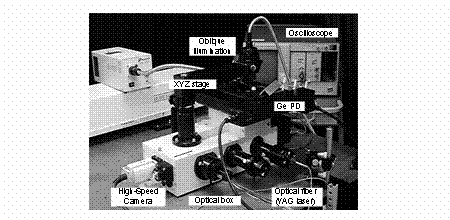
Fig.2.
Photograph of experimental apparatus to visualize the microflow around
roter.
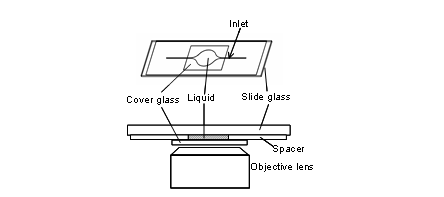
Fig. 3. Fabricated sample chamber
sealed with cover glass. When liquid is dropped at the edge of the inlet it
moves toward the center by surface tension